Even when the public understands the relevance of statistics, the doing can seem unexpectedly, perhaps even unnecessarily, involved. This is why experts can tout slogans like “evidence-based policy” and “data-driven decision-making” to widespread public approval, while important decisions continue to be made based on whims and the government quietly starves the agencies that actually generate the evidence for decisions.
This paradox is easily observed in many developing countries where governments can be quite conversant with data pertaining to customs and banking activity and leading businesses can have quite sophisticated analytics programs, even while basic information like how many people live in the country or birth and death rates are patchy at best.
The issue is not simply state capacity to do statistics, it is the desire to do it. In reality, statistics is not simply a technical activity that is left to PhDs hunched over computers, it is a highly political endeavour because the outcomes often determine how much political representation a people get, how much money goes to a region and how well those who hold power are performing. In this piece I will argue that the political economy of statistics is the primary reason why many states struggle to do it properly and then I will identify best practices for doing statistics when it’s politically hard.
Counting requires more than skill
In the United Nations’
Fundamental Principles of Official Statistics which provides 10 principles to guide “good statistics”, professional impartiality is placed even before adherence to good scientific principles. This may sound like a professional norm, but it is, in reality, an institutional design problem. When statisticians don’t have professional independence, the same incentives that drive politicians and public spending may start to seep into their work.
Statistics doesn’t fail because of a lack of skilled statisticians and economists or because of a poorly written professional ethics guide, it fails because the basic foundations of a strong statistical system are missing or unstable. Independence and impartiality are at the centre of this foundation. Practically this means predictable financing, a clear legal mandate, and good governance.
Predictable funding and a clear legal mandate allow statistical agencies to attract skilled staff and provide a career track and incentives that are strong enough to keep them. These in turn are what give statisticians the ability to choose their methods, and publish their results without fear.
Good statistics also requires good governance. This includes transparency, documenting sampling logic, operational procedures, and quality assurance processes and results in a manner that is auditable. Good governance also involves enforced ethics and integration with data sources not generated by the statistical agency, such as administrative records.
Unfortunately, most of these investments take time to yield results. Factor in resource scarcity and the fact that the results of these investments may not be clearly visible to the general public, and these investments appear even more politically inconvenient. A new road before an election will generate the sort of positive publicity that a new statistical report cannot. A new hospital wing will yield a permanent plaque, photos and visible infrastructure that a statistical methodology breakthrough cannot offer, even if that breakthrough is needed to know where to invest in new hospital wings. A rational politician, homo economicus, will almost always prioritise these sorts of visible investments when constraints force them to choose.
International support helps break this reasoning chain but with some undesirable consequences. The World Bank’s Trust Fund for Statistical Capacity Building (TFSCB), for example, has disbursed hundreds of grants totalling over $100 million across many countries over two decades. Similarly, the Demographic and Health Surveys (DHS) provides critical health and population data for many countries with substantial donor and technical support. However, although external support has been meaningful, it can be simultaneously not enough while creating serious dependence. The Partnership in Statistics for Development in the 21st Century (PARIS21), an initiative of the UN and other multilateral organisations, has
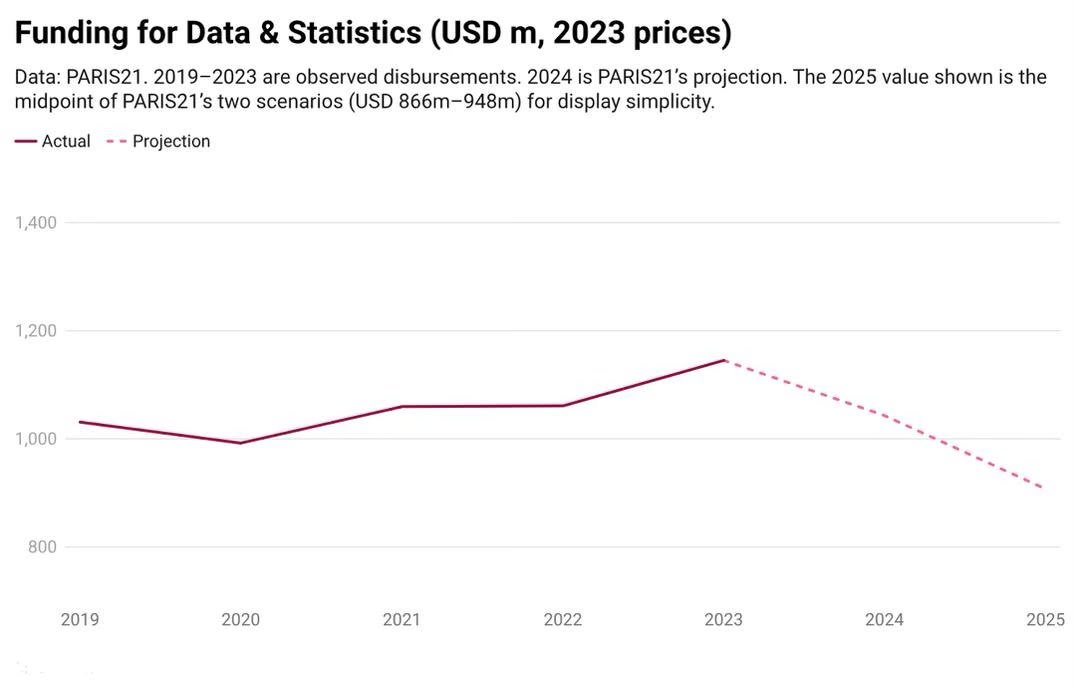
estimated that the share of official development assistance that goes to statistics needs to at least double from 0.33% to 0.7% to meet global statistical capacity ambitions. States can also become accustomed to treating statistics as something to be done as part of externally funded projects rather than as an internal state capacity to develop and nurture. This is not a feasible long-term strategy. PARIS21 expects global official development assistance (ODA) to statistics to decline for the foreseeable future after hitting a peak in 2023. ODA refers to funding from external governments and multilateral agencies.
Funding for Data & Statistics chart
Counting people is a power struggle
Censuses are particularly politically charged. Population figures are used to determine the number of political representatives and political constituencies a people get, as well as the share of state revenues allocated to these representatives and constituencies. For politicians, the ‘right’ figures can significantly improve their influence, whereas the ‘wrong’ figure, which leads to the elimination or merger of constituencies may end their career. Naturally, censuses are often a recurring site of conflict.
In Nigeria, the last completed census (2006) was widely criticised for being a thinly veiled political contest for state resources rather than a true counting exercise. Bola Tinubu, then governor of Lagos State and current Nigerian president, dismissed the figures and called for a new census, referring to a parallel count in Lagos that yielded a significantly higher population count. Later, Festus Odimegwu, future boss of the National Population Commission, the agency responsible for the census, would summarise the credibility problem
succinctly: “We do not really know our population; that is the truth of the matter because all the census ever conducted in this country ended in controversy. We do our work but politicians interfere and at the end, you do not really know what population or census figures are.”
The result of that census has been a quiet normalisation of estimates nobody fully believes. Policymakers and economic actors can’t plan properly. Nigerians instinctively treat official statistics as propaganda even when an alternative does not exist, and statisticians learnt that telling the truth is secondary or even dangerous.
Is ‘statistician’ latin for scapegoat?
Around the time of the Nigerian census, the Greek statistical agency (ELSTAT) was publishing public finance statistics that were widely regarded as being dubious. Politicians were known to lean on ELSTAT for favourable figures that hid the true extent of public borrowing. So in 2010, respected IMF economist Andreas Georgiou was appointed to lead the agency and improve the reputation of its outputs. Georgiou led the revision of Greece’s public finance figures for 2006–2009, which ultimately showed a much higher budget deficit than previously reported. This eventually led to gruelling austerity measures being imposed on Greece by international creditors.
The resulting public anger was then directed at Georgiou by both right- and left-wing politicians seeking to escape the blame for Greece’s public mismanagement. Georgiou was accused of being a willing tool for international creditors desperate to impose austerity measures on Greece for their own benefit. He was later charged with violation of duty, complicity against the state and slander in a legal ordeal that has been characterised as
kafkaesque and that continued over a decade later. Major statistical bodies including Eurostat, the International Statistical Institute and the American Statistical Association have decried what they consider to be Georgiou’s unfair persecution, and a violation of the principle of professional independence in statistics.
The lesson this tale sends to statisticians is that embarrassing figures can create a potent urge to shoot the messenger. Most statisticians do not want to be shot.
In Argentina, statisticians faced similar pressures, leading to periods when official inflation figures and other statistics lost credibility. This resulted in the proliferation of competing private estimates and a collapse of trust in statistical authorities. In 2013, Argentina became the first country
censured by the IMF for failing to produce accurate data.
These cases highlight what is missing from the “capacity building” narrative: The core constraint may not always be whether local statisticians know how to do statistics, but whether the institutions and political economy give them leeway to do so.
Why some states measure trade better than poverty
Not all statistical endeavours are built the same, though. Systems for the collection and recording of trade and customs data are often better funded and more modernised than many other data systems because they lead to reduced leakages and better revenue collection for the state. In addition, trade and customs data, even when bad, tends to be significantly less embarrassing for politicians than poverty or infant mortality statistics, for instance.
Customs and trade data are not perfect, and tools like
ASYCUDA, a computerised customs management system developed by UNCTAD help in this regard, but the truth is that when statistics align with political incentives, statistical capacity gets built, maintained and upgraded with little external support.
Inconvenient statistics need their own champions too.
Better statistics is a long-term technical endeavour
Surveys and censuses get the most attention, but registries and interoperable administrative records systems are the plumbing that make statistical systems complete. They are also where long-term underinvestment does the most damage.
Civil registration and vital statistics systems (CRVS), for example, capture births, deaths, causes of death and other important population metrics which are critical for the production of good statistics. However, the data capture is typically not managed by statisticians and is usually highly decentralised. CRVS systems need to be able to generate data that is readily compilable across administrative divisions, geographies and time, and that can be combined with other data sources to yield meaningful insight.
Ghana’s recent push for digital birth registration illustrates both promise and tradeoffs. The new system improves accuracy and speeds up processing by reducing the need for paperwork and physical records. According to
UNICEF Ghana, this system has been used across over 150 districts and has largely eliminated problems posed by paper/form shortages. On the other hand, the system seems to exacerbate the existing urban-rural data collection/quality gap. Rural districts have less reliable connectivity, electricity, and tech support. As a whole, Ghana also faces other operational constraints that hinder uptake and use of the new system including: staffing gaps, weak logistics for field tech support, and low public awareness and interoperability issues with other systems. Like other digital identity-related systems, this one also raises questions around data protection and secure handling which matter for sustaining confidence in the system.
When CRVS systems like the one in Ghana are well-embedded, they don’t just benefit the statistics nerds. By linking other records on school enrolment, welfare benefits, taxation and business registration, the state is better able to coordinate, and statistical offices produce better insights while reducing costs by eliminating many repeated expensive statistical surveys. The World Bank’s World Development Report 2021 also notes that improved CRVS and interoperability would allow data collected for one purpose to be used in unanticipated ways that unlock additional value for the population.
Good statistics needs a political economy that supports long-term investment in statistical systems and interoperability.
Building statistics in politically hard environments
There is no single reform that solves the politics of statistics, but the most resilient systems tend to have a few characteristics in common.
1) Lock in professional independence
The National Institute of Statistics and Geography (INEGI), Mexico’s national statistics agency, is often cited as an example of a system with strong professional independence because its independence is explicit in the country’s constitution. In 2006, Article 26 of Mexico’s Constitution was amended to create the National System of Statistical and Geographical Information (SNIEG) which is Mexico’s official framework for producing statistics and geographic information across government. The amendment also assigned the coordination of SNIEG to INEGI. Under Article 26, section B, INEGI is established as a public body with technical and managerial autonomy, and the information produced within SNIEG is treated as official and mandatory for use across all levels of government.
Professional independence does not eliminate politics in statistics, but it changes the terms of engagement by creating standards that leaders must publicly break at some political cost if they wish to interfere. This makes interference less likely.
2) Lock in funding
PARIS21’s guidance on national statistical strategies emphasises predictable funding for the long-term. When Madagascar evaluated its first national statistics strategy in 2023, insufficient budget allocation was
noted as a key issue to be addressed in the revised strategy.
When statistical agencies have to lobby for funding for routine projects or when they only receive funding when “money remains”, the statistical system is destined for political manipulation and failure. The key is to treat statistical systems as infrastructure rather than as a series of ad hoc projects. So for example, even though censuses may be scheduled every decade, a tenth of the funding for the census year can be allocated to an investment account in each annual budget.
At a minimum great statistical systems have:
- Protected or multi-year appropriations for core surveys and registries
- Protected staffing baseline to ensure a minimum capacity of the statistical agency
3) Start where it's easy, then go hard
Reformists should use less controversial systems as wedges. If the state already has strong incentives to collect good customs or tax data, then data governance rules, quality assurance practices and interoperability can be built there and these structures can then be extended to more politically charged statistics.
This strategy would prove that better statistics is feasible locally, and contribute to building the institutional capacity needed to do it.
4) Use international standards as guardrails
Global data standards and statistical principles create an external reference that proponents of better statistics can lean on. They set minimum standards and make interference or manipulation easier to point out. The UN’s 10 “Fundamental Principles of Official Statistics” is a great place to start. It is not about outsourcing sovereignty, it’s about standing on the shoulders of global consensus.
5) Build trust and keep it a priority
There’s no point producing better statistics if no one believes you. Trust requires transparent methods and quality assurance that independent experts can scrutinise and criticise; prioritising a culture of rapid correction when errors are spotted over one of blame; and strong confidentiality and data security when dealing with sensitive data.
To keep trust, statistical agencies also need to have the courage to refuse to say what their data doesn’t, and to be clear about the level of precision that their methods allow.
6) Build local constituencies
Statistics that are only really used by international donors and partners are vulnerable. Leaders will treat these as donor compliance and cut it when external funding declines. Statistical systems are more robust when they have local constituencies.
Ironically, the path to less political interference in statistics is statistics that is useful and used in domestic politics.
Here are examples of what constituency building success looks like for statistical systems:
- Journalists and researchers rely on statistical publications to track policy performance
- Policymakers use it to benchmark service delivery
- Civil society uses it to regularly target and track interventions
- Businesses rely on these statistics to plan
- Courts regularly reference official statistics in disputes
Ultimately, reformists must recognise the inherent political nature of statistics and embrace it in a healthy way. The job is never truly done, but when your statistical system can publish politically relevant bad news and remain standing, stop for a minute and treat yourself. The constant vigilance and defence that better statistics requires takes strength, and who better to give it than those who have brought it this far?